Process
Although the project was none of our first choices, we decided that it itself could be beneficial, as we had no predecided thoughts on what the solution would look like. This mindset allowed us to keep an open mind in the research phase, trying to get as close to the root cause as possible.
In order to connect with the problem, and thus shape our own project, we asked ourselves numerous questions, including:
- When it comes to optimising energy efficiency, optimise towards what?
- What is the correlation between efficiency in data and efficiency in energy?
- Friction → shall it be increased or decreased?
- What could a dashboard be used for, and for whom?
- "Making things better and cheaper", better in terms of what and cheaper for who?
- How do social inequalities affect the access to efficient and green energy?
- How does the way we measure energy consumption influence our consumption/efficiency?
- What are the principal problems of energy efficiency in Paris' housing/buildings and what are energy-efficient solutions?
- How can we increase consumption efficiency in economic and sustainable terms?
Right before our bootcamp, we landed on the research question: How does the way we measure energy consumption influence our consumption/efficiency?
This became our compass, trying to challenge the limits of DPE, in order to gain a more holistic way of measuring our consumption.
Bootcamp
During bootcamp, Amelie attempted to start a movement, Nora tried getting to the bottom of our user, who we were not fully sure who was at the moment, Nicodème and Gaspard worked on standardising, organising, and who knows what, with the dirty data, and Hannah attempted to manage what could be managed.
It was a challenging, but insightful, week. Being split up, having to independently frame and describe our problem to outsiders allowed us to gain in-depth understanding. Daily debriefs allowed us to stay aligned, working on different things towards the same vision of not only measuring energy consumption more accurately, but also letting our users gain insights into how they might change their consumption, in order to save on costs and emissions.
We conducted interviews targeting homeowners, while later realising that there is no reason for renters, and anyone who pays their own electricity bills, to be excluded. With additional interviews later in the process, we understood that they both needed the same thing, as well as being incentivised by costs to a greater extent than emissions itself. More users and interviews will come later.
MVP
During the week, we constructed our MVP. Although the data was not ready for the algorithm to be built on it, it allowed us to visualise our goal. We created a platform where the user inserts information regarding their consumption, and the platform uses the input in order to generate advice for both changes and renovations that can be done, including an overview of both monetary and emission costs, long-term and short-term gains, which makes the cost-benefit analysis easily accessible for all.
It has by no means been a linear journey, both our project and us as a team has developed front and back, and to all sides. We have dared to explore, and dared to not know the answer. Thus, we believe that we have built a solid foundation, allowing us to develop both ourselves and our future prototype together.
Continuation after our first Deliverable
For the continuation of the first term, up until our first deliverable, our roles and responsibilities remained similar to what they were during the bootcamp. However, at the beginning of the second term, we lost track a little bit. With a pause during winter break, we struggled a bit with getting back into the flow.
Something we found useful was to create clear design principles. Our motivation for doing the project has always been to guide people towards easily grasping how they may gain control over their consumption, to reduce their costs and emissions. However, this was not always easily transformed into the platform. To guide us, we created our design principles at the intersection of our values, what would bring the user value, and feasibility. Our closest values include transparency, accessibility, and clear understanding.
| Value | Brief description | Actual status | Vision |
|---|---|---|---|
| Transparency | Explain simply what the platform can and cannot do, with accuracy levels. | In process | Prototype |
| Accessibility | The platform should be easily interpreted by the users and make it easily navigable. | Content for now | First Version |
| Explain the process | Provide overview of how things are calculated, and why we factor in certain things and not other. | In process | Final Version |
| Explain the output | Provide information on how to interpret the results and what they are based on (focus on demonstrating ROI). | In process | Prototype |
| Keep users "under control" | Directing the User by clear instructions and design. | Content for now | First Version |
| Collect user data | Use the data to make the platform more actual → transparency here too. | To explore later | Final Version |
The creation of our design principles was not about constructing something new, but to give us a moment to collectively reflect on how we want to do things, and why. Together with updating our KANBAN, it helped us regain motivation and opened for conversations about our roles, which had grown a little less clear.
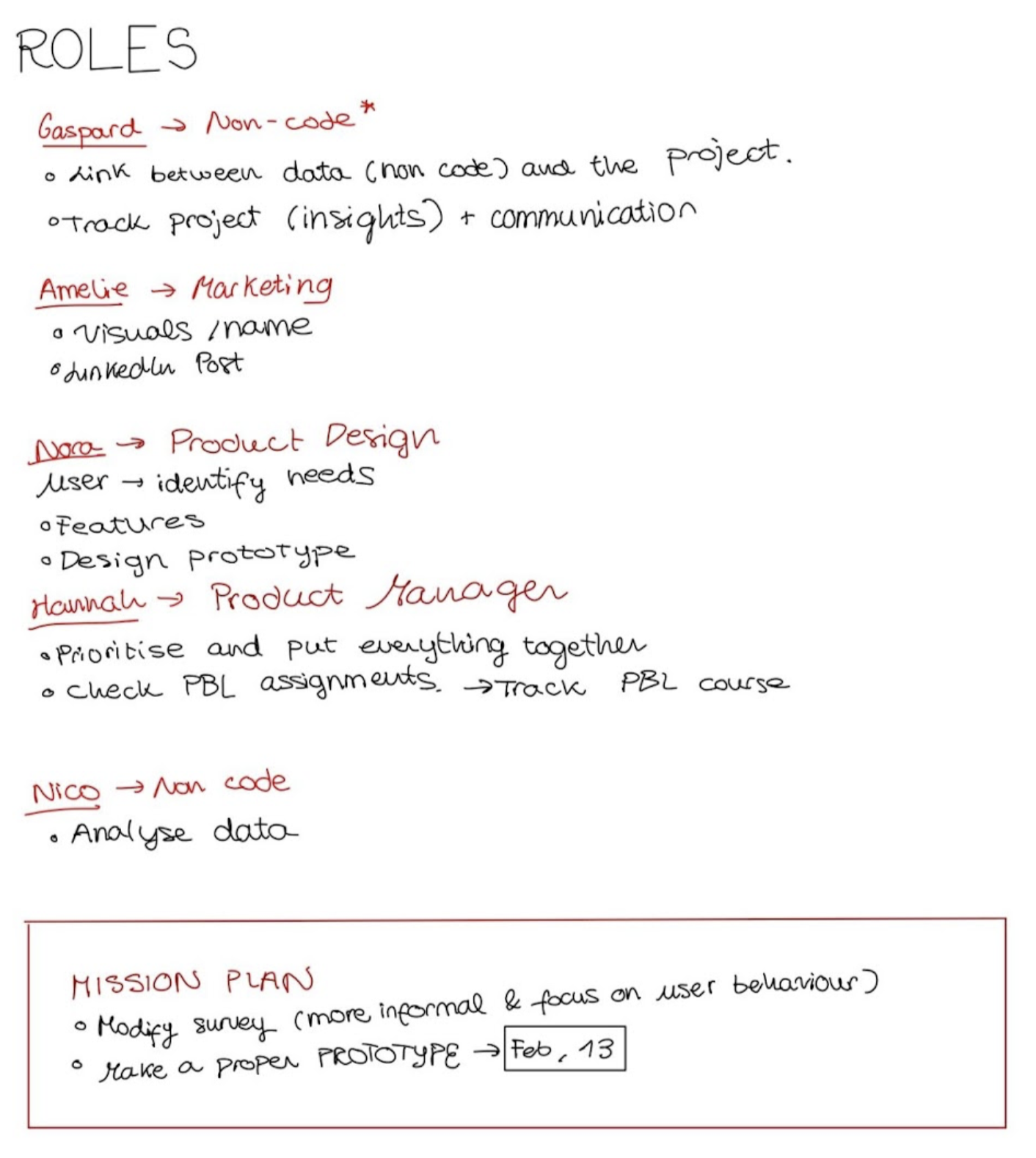
After reorganising and recapping our responsibilities, as a team and individuals, we embarked on our first round of testing, with the aim to test usability and clarity. It was highly successful, with both clear confirmations of what worked, especially within visual design, but also constructive feedback on what was lacking, mostly to do with messaging. This gave us a clear aim to work towards.
Gaspard was taking over the responsibility of the front end, after Hannah constructed the MVP and was responsible for iterations throughout the first term and first round of testing. Gaspard managed to transport the MVP from Base44 to Lovable, to make it more compatible with the back end. It was challenging to capture the same things the users found useful, and forced us to rethink every choice. After multiple rounds of iterations and feedback internally, we ended up with a prototype we were happy with. Although it took time, the features and design choices in this version were more intentional and thought through, thus, not wasted time at all.
However, there was still room for improvement, especially when it came to messaging. The goal of the second round of testing was clear: to check that we were indeed able to preserve the value of the product after switching no-code platforms, and to see whether our messaging had improved.